Showing posts with label paper crafting. Show all posts

Monday, 12 October 2020

Vintage Style Botanical Lace Dyeing - Part 1.

I love using lace in my art journaling. It's just, they never seem to get the colours right these days... I want the laces to look old, actually used and worn and loved, faded, stained... So, I tried to dye them with tea as that's what people seem to do. I wasn't satisfied. So, my researcher side kicked in and I thought that if tea wasn't right, how about adding some coffee? Better. How about using different kinds of tea or coffee, does that matter? (Yes, it does.) And so on. It's a never ending adventure, I can assure you, dyeing lace. 

Usually I just throw in whatever I happen to have at hand, couple of these tea bags, just a bit of coffee (usually with Oops Effect, when my little turns out to be the whole bottle accidentally falling into the mix), some amount of water, some amount of time.The end result is different every time, as I want it to; that way I have lots of lovely vintage tone laces in varied hues. Also, the laces itself are a handful, as there are a huge difference if you use 100% natural fiber laces or synthetic ones, they all react differently, take different amount of time to absorb the dyes, and so on. But that's the fun of it, being a Lace Adventurer!


Now I've made as "scientific" test dyes as one can make with laces, making nogtes all the time, measuring everything, so you could see how different incredients make different hues, and how time can or then does not affect to the end result. 

Please note, in this blog post I'll explain only my own way of vintage style dyeing, so no actual colours are what we are after, but naturally vintage looking laces and silks.

Just a quick note before we start. Believe me, it's very simple process, dyeing lace. It takes triple the time to write the process than actually do it, so go ahead and try, maybe just not use your handmade heirloom laces, but something you are happy and comfortable to start to play with.

((Another quick word, a disclaimer, a warning, CAUTION! etc. Always use kitchen tools and kitchen ware that are solely reserved for dyeing purposes. Do not use the same items you use when cooking food, just in case. Also, it's completely ok with the tea and coffee stuff, but when we start adding interesting incredients like rusty nailheads, do make sure your ventilation is working properly. Be careful with the hot liquids, hot oven, and what else should I warn you about? Just, be careful and use your brain and common sense, thank you. End of disclaimer.))

We start with the materials needed. I explain in detail what and why, so you don't need to torn your hair because of too vague list; she said "a bowl" but do I need a big or small or plastic etc.

You will need...

* A stainless steel bowl/pot/kettle that can stand the heat

I use Ikea's Blanda Blank 36cm wide, approx. 4L - and this is not an advert, just a tip that it's an excellent for dyeing purposes. I would not recommend using plastic bowls, as they might react interestingly with hot liquids that include all kinds of ominous thingies like rusty nailheads. The same with glass ware; we are handling boiling hot liquids, so there's always a danger them to break. Use as big as you can get. (Ok, there's some limits how big, but you know, one that you can actually handle and put on your table.)

* A large spoon/ladle/pliers that can stand the heat

(Just maybe not made from wood). This is for handling the hot laces, without you needing to burn your fingers. Optional, but highly recommended.

*  Boiled water

* Tea Bags

I recommend tea bags, or if you use loose tea, please put it in a sieve or something. I prefer Earl Grey for its hue, but you need to find your our favourite by testing. And also, you don't need to use the most expensive tea leaves handpicked from Himalayan slopes at sunrise, but just, you know, the cheapes you can find would be just perfect. The laces won't mind. 

(Also, I recommend saving the used teabags for your crafting projects, a theme for another blog post, so we just leave it with that for now; save them, empty them, and put aside to dry.)

* Instant Coffee

The same as with the tea; you can use cheapest you can find. Although, it really matters what kind of coffee you use. If you use stuff from coffee machine, you'll need gallons of it, it's too diluted. Although I have a habit of pouring all the left overs into my "dye soup" if there is some. So, instant coffee, as you can easily spoon some more to the soup if needed. I have tested several different brands and labels inside brands and have noticed some give more dirtyish, gold brown hues than others, so you just need to test to find your favourites. Nestle's Nescafe Gold is true to its word and quite a lovely golden shade. (It's a subject entirely different, if I would ever be voluntarily drinking that stuff.)

* Laces 

Any lace will do. They react differently, depending to the material they are made of; synthetic, cotton, silk, linen... So, test and find your favourites to work with!

* Kitchen paper and/or baking paper for drying


Next level materials:

* Powdered Cinnamon: not the quality stuff, the cheapest will do.

* Dark Chocolate Powder: not the quality stuff, the cheapest will do.

* An old kettle: for heating the dye mix, so it'll not be usable for cooking food after this!

* Rusty nailheads or other rusty metallic objects that fit into your bowl.

* Fresh sage leaves

I use clary sage (Salvia sclarea var. turkestanica), because I happen to have masses in our kitchen garden, but I have tested with ordinary sage, too, and it'll have almos the samee effect, so no need to start a kitchen garden, plant clary sage seeds, grow them, and then test this one out.


 Variables

All the fabrics, laces, silks, papers, everything especially containg natural fibres, have a different way of reacting with natural dyes, so it indeed is a variable of its own. The water you are using is another variable (pH etc.), and so on. So, you might not get the exact shades you see in my example photos, but don't worry; dyeing is fun, so the more you try, the more you learn and understand it, and you will get there and find the colours you are after!

The colour will depend espcially on the tea and coffee you use. Ceylon and English Breakfast I happened to have at hand for the test, are much more yellow than my preferred choices of more red brownish tee, like Earl Grey. Also, my Nescafe Original isn't as good a warm brown as Nescafe Golden, more dirty colour.

Time is an important variable, too, so I have used exactly the same amount of time for each test rounds (of exactly the same materials). I decided to show you also the differencee between a quick dip and a longer soaking:

Quick dip = 10 seconds

Long soak = 1 hour

Here, in the photo above are the materials I used for this blogpost test dyeing. I choosed a lot of different materials to give you the idea how they react. There might be considerable difference in the end result, depending on the material and dyeing time - or, there might be no reaction or no difference at all!   

Drying

If you have small amounts of laces or fabrics or silks to dry, they will dry perfectly well on top of a baking sheet. If you have possibility to use outdoors drying, that'd be perfect - the dripping dye liquid might stain your floor, if you let them dry in a drying rack inside.

A way to quicken the process of drying is to use oven. A word of caution; please do not ever leave the oven unsupervised if you dry your laces; especially synthetic materials are a fire hazard. Therefore I do not recommend using oven for synthetic materials at all. On the other hand, I do use oven for drying pure cotton and silk materials, but only approx. 1-5 minutes, in 150 Celsius degrees, under my alert eyes all the time. 


1. Tea and Coffee - The Basic Vintage Dyeing

With this basic dyeing method, you'll have nice and easy vintage style laces and silks. Here's how I did it, with exact measurements. For each and every test round, I used this same basic dye mix, I just added more incgredients into this original one.

BASIC TEA & COFFEE DYE MIX

* Pour 2 litres of boiling water into the (stainless steel) bowl.

* Add 14 (I used 10 Ceylon teabags and 4 English Breakfast teabags) into the bowl.

* Add 4 tablespoon of instant coffee.

* Stir and let the water absorb the colours from the teabags and coffee until you feel it's quite safe for you to put your fingers into the mix (without burning your fingers, please).

* Put your laces/silks into the bowl, stir well, let them absorb the colour, and take out after you are satisfied with the result.

* Rinse well and dry. 

That's it! It's that simple.


Optional, but nice - The Next Level Dyeing

Now you know how easy it is to get some colour into your laces, I'll tell you more. When you add cinnamon to your dyeing mix, it'll not only give the most wonderful scent, but also gives a much more gentle, warmer tone to the laces and silks. Then, when you add on top of that a bit of dark chocolate powder, the colour changes again... For me, the favourite effect comes when I add rusty nails (you know, the ones you use with hammer) and just a bit of sage to the mix. The rust causes a chemical reaction and turns the colours into gorgeusly soft grey tones. And a bit of sage deepens the colours.
 
Now, I have a massive hole in my very efficient tests. Namely, I used my already black stained, rusty nails instead of "fresh" rusty ones. How to get them to turn into a black mess? I boiled them with plants for a couple of hours while dyeing papers (another blogpost entirely), so maybe you could do the same; add rusty metal objects like nails, screws, keys, anything you will never need to anything but dyeing afterwards, as tehy'll be absolutely deliciously ruined. They'll end up looking like this:


2. Tea, Coffee & Cinnamon Dye

Cinnamon adds a bit depth and warmth to the mix, but it does not come out in the photo as well as it does in real life. Also, if you use Earl Greay or other darker black teas for the mix instead of my yellowish Ceylon mix, the colours you'll get with cinnamon, are much deeper!

The basic mix is the same I used for the tea&coffee dye, I just added cinnamon into the original one instead of making a new dye mix.

TEA, COFFEE & CINNAMON DYE MIX

* Pour 2 litres of boiling water into the (stainless steel) bowl.

* Add 14 (I used 10 Ceylon teabags and 4 English Breakfast teabags) into the bowl.

* Add 4 tablespoon of instant coffee.

* Add 1 tablespoon of cinnamon powder.

* Stir and let the water absorb the colours until you feel it's quite safe for you to put your fingers into the mix (without burning your fingers, please).

* Put your laces/silks into the bowl, stir well, let them absorb the colour, and take out after you are satisfied with the result.

* Rinse well and dry. 


3. Tea, Coffee, Cinnamon & Chocolate Dye

Like cinnamon, chocolate adds a lovely brown depth and warmth to the mix. (Again, if you use Earl Greay or other darker black teas for the mix instead of my yellowish Ceylon mix, the colours you'll get with cinnamon, are much deeper!)

The basic mix is the same I used for the tea&coffee dye, with cinnamon. I just added dark chocolate powder to 2 dl boiling water (to make sure sure the chocolate melts and blends into the liquid mix evenly), and poured it into the dye mix. I used van Houten's dark chocolate powder.

TEA, COFFEE, CINNAMON & CHOCOLATE DYE MIX

* Pour 2 litres of boiling water into the (stainless steel) bowl.

* Add 14 (I used 10 Ceylon teabags and 4 English Breakfast teabags) into the bowl.

* Add 4 tablespoon of instant coffee.

* Add 1 tablespoon of cinnamon powder. 

* Add 1 tablespoon of dark chocolate powder mixed in 2 dl boiling water.

* Stir and let the water absorb the colours until you feel it's quite safe for you to put your fingers into the mix (without burning your fingers, please).

* Put your laces/silks into the bowl, stir well, let them absorb the colour, and take out after you are satisfied with the result.

* Rinse well and dry.


4. Tea, Coffee, Cinnamon, Chocolate & Rust Dye

If cinnamon and chocolate add some lovely depth and warmth to the dye mix, wait until you have tested some rust effect!

The basic mix is the same I added tea&coffee dye, with cinnamon and chocolate. For this mixture, I did as follows:

I took my dyeing kettle (it's 5L one) and put rusty nails there. I poured the whole dye mixture into the kettle, added  a sage leaf and let it boil. 

The difference of this mixture can be seen in the two versions of A and B: the end result is different, if you dye your laces in boiling hot mixture and in a cooled mixture! 

The boiling mixture will give you lovely brownish grey or greyish brown results, and the cooled mixture will give soft grey tones. Proceed the same way in both, just leave the mixture cool before testing the B. option.

 TEA, COFFEE, CINNAMON, CHOCOLATE & RUST DYE 

-in boiling water // in cooled water-

* Pour 2 litres of boiling water into the (stainless steel) bowl.

* Add 14 (I used 10 Ceylon teabags and 4 English Breakfast teabags) into the bowl.

* Add 4 tablespoon of instant coffee.

* Add 1 tablespoon of cinnamon powder. 

* Add 1 tablespoon of dark chocolate powder mixed in 2 dl boiling water.

* 34 rusty nails.

* 1 leaf of sage or clary sage.

* Let the mixture boil. (And cool, if you want only soft grey tones.)

* Stir and let the water absorb the colours until you feel it's quite safe for you to put your fingers into the mix (without burning your fingers, please).

* Put your laces/silks into the bowl, stir well, let them absorb the colour, and take out after you are satisfied with the result.

* Rinse well and dry. 
 
***

And that's it, really, for a start. 

There is no limit there, how you can play with these incredients. Add more tea, leave coffee out. Add cardamom, with a hint of common yarrow. Add more rusty items, let them boil or soak longer. And so on, so on, and endlessly so.

Here are some photos of my test materials in neatish rows, so you can see the difference (or none) beetween the dyes and the time. Test what are your favourites!


Yay, you made it here! Thank you, darling for your company! Wishing you inspiring moments with dyeing your laces in vintage style. And, hopefully soon I'll finish my tutorial for botanically dyed papers, and after that' we'll get back to the botanical lace dyeing and have proper plant soaking moments...

Emilia, xx


P.S. All rights reserved. (To the mistakes, too.)  The pictures, the measurements and all are my own work, so please do not share them as your own but tag me, harvinaisenkauniselama on social media, if you got inspired!

Tuesday, 24 March 2020

How to Use Mixed Media Part 3 - gesso


(* This series of tutorials is aimed for beginners, but of course advanced mixed media artists are very welcomed to peek how I use these materials, too. *)

When the world is spinning around faster and faster and being more anxious than ever, it really is time for some serious action. Be prepared? Ok, here we go. Take deep breath and try to relax your shoulders and empty your faster-than-Earth-spinning mind. Maybe a nice cuppa would do you good, too? (Being in the highest risk groups, I know COVID-19 isn’t anything to joke about, but I'm trying to get my mind – an yours – elsewhere.) For just a moment, let’s pretend there isn’t anything more serious to concentrate than… GESSO.

With something as simple, easygoing, and friendly as gesso, you can change the whole concept of your art journaling. If you are thinking of adding one medium to your repertoire, I’d recommend starting with gesso. With it, you can play endlessly. But first, some facts in case you really have no idea what gesso is.


What is gesso, anyway?

It is The Medium for artist, actually. It’s most often used as a primer, preparing the canvases for painting, but you can apply gesso to pretty much any surface, like to a journal page. Gesso protects the surface, making it stiffer and preventing paints to absorb into the canvas/paper. After adding gesso, you can add paints or whatever media you choose to use, without damaging the surface you are working with. You can also use gesso as a paint, as it leaves a nice, thin white surface when dried.

https://www.primamarketinginc.com/product/art-basics-heavy-gesso-white-17-fl-oz/

Gesso is white, usually acrylic based, white medium that dries matte white. (There’s also clear and black gesso, the idea of them is the same.) It doesn’t have a strong smell, only a tiny chalky whiff. It is water based, so you can wash your hands and tools with water and soap, but after gesso has dried, its permanent. (That’s kind of the whole point of a primer.) So, after it’s dry, there’s no way of getting it out of for example, your clothes. Or from your paint brush.


How to use it?
**Just a tip that goes with everything new you are working with: always test first! Test onto a scrap of paper first, and when you are comfortable with using the medium or too, then go ahead with your actual craft project!**

**Consider adding one of my secret tools to your must-have list: baby wipes. Kitchen paper is another thing I always have nearby when I craft, but baby wipes are the thing I really can’t craft without. I really recommend always having kitchen paper (and those baby wipes) at hand when working with mixed media, as it is better to have them right there than to rush to get one from another room when it is a high alert crafting emergency going on.**
 
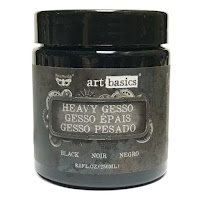
Gesso is a simple medium to work with. It’s not smelly, it’s washable. It’s a very easily tamed crafty pet to own. There’s endless number of brands there and you can choose any of them. I’m using Finnabair’s Art Basic White Heavy Gesso


You will need:
-       a pot of gesso
-       a brush (size depends on the way you are using gesso)
-       a jar of water (for sticking your brush there after using, or thinning gesso
-       recommendation: kitchen paper, baby wipes

In journaling, gesso can be used almost as many ways as there are users. But, here’s a couple of tips, the rest is up to you, to experiment, to test, to get to know it, to have fun.


In my tutorial video there are different examples of how I use gesso, so here’s only a cursory summary, as it’s much easier to show than write to explain how flexible medium gesso is and how to actually use them in different ways.


Using Gesso as a primer to seal a journal page

Painting a blank journal page with gesso is not the first thing in my mind - except if you are intending to use other mediums on top of it and you need to use a primer to seal the paper. However, if you have a junk journal filled with different kind of papers, it’s another story. If you want to hide the entire text or colour or whatever it is that doesn’t make your soul sing, add a generous amount of gesso with your paint brush (you will soon see if you need to add a bit water into your brush or is the gesso you are using workable and easily spreading to the page without any water) and hide everything. Or, if you text or image pages and find the details of your junk journal page too distinctive, giving a gentle wash of gesso would do wonders. In that case, work with wet brush when adding gesso.


Using Gesso as a special effects stuff

The more you get to know gesso, the more you realise it has to give to your journaling.

Made a mistake in your junk journal? Add some gesso and start again.
 
Want to fade the outlines or edges of your ephemera, to blend into the journal page? Add gesso with gentle brush strokes and use also a baby wipe to blend the effect.

Want a lovely white coat over your project? With a dry brush and only a tiniest amount of gesso, gently, oh so caressingly gently add a coating of gesso to flowers, to embellishments, to images, ephemera…

In need of a softening white spray? With a wet brush, take a tiny amount of gesso, and with your finger splash it to the page. It’ll make an immediate, softening, light effect.
And so on and so on. I’m sure at this point you can’t wait to be able to test it, so…


So, where to find it?

It’s so commonly used a medium that it is easily available anywhere. It depends on the country you live in, but I’d suggest trying craft or art stores. Here in Finland you can find it in bookstores, and big general stores, too. Googling is a good way to find it, too…

In Finland you can find it for example here:


Happy crafting, darlings, and #stayhomeandbecreative!

Emilia xx

Wednesday, 8 May 2019

Step By Step Tutorial – Enchanted Forest Fairy Queen


I happen to live in a household full of vintage papers. Therefore, it’s not hardly surprising I stumble upon lovely old things every once in a while, and think that “oh, this one is perfect for Project No. 73951 or this for No. 6081538, so I need to put this aside to wait for a while.” Only, that “a while” is a very tricky definition. I suspect it might belong to the same category with “tomorrow”, that mysterious place of overly optimism. 

Then, sometimes the time and place, the phase of the moon, The Crafty Mood, and all the other thousands of tiny aspects and details fell in place and you just realise it’s now or never. I wanted to have a quick craft session. Do you know the feeling I just quickly - and eighteen hours later you realise you haven’t even got to eat; you have had that tiny moment slightly expanding. (Of course, with me 18 hours would be a vast exaggeration, but an hour instead of 15 minutes?)
 
My husband asked me to make a simple tutorial for Varalusikka, maybe using mixed media and vintage papers. Then I remembered I had put aside this gorgeous German Lexicon book cover, from 1906, and thought I would make something really easy and simple and take photos as I go.

As the cover was delicious mix of deep moss green, gold, and weathered (real) leather, I thought some kind of a forest theme would be lovely and started to collect some inspirational items on my desk. I had no idea what I would be doing, but that’s no news, I hardly have anyway. 

So, I had a new Finnabair stencil I had been waiting to be able to test, as well as the Finnabair Icing Paste I had used only once and wanted to double check it is just as fantastic I was thinking when first time using it. (Oh yes, it was.) On my desk had been whispering me for ages was a 49andMarket’s new paper pad and flowers, and I hadn’t got a chance to use the lovely Tim Holtz cardboard frames either, so I decided to start from there and see where I’ll end up.

It took me several days, but in the end I have a book covers ready and waiting for an altered vintage book, filled with enchanted magic.  


STEP BY STEP
Follow my journey through the enchanted forest, step by step.

STEP 1.
I had the book cover chosen for a kind of a canvas, but I wanted to have a bit more 3D effect coming through behind all the forthcoming layers.

So, I took a 49 and Market sheet and with a ruler, ripped a suitable sized part as a second base. Then I ripped and folded the edges look like dried moss, lichen or birchbark.

When I was happy with the outcome, I distressed all the edges with Distress Ink (walnut stain colour).


STEP 2.
Using very dry brush, I gently added a soft veil of gesso here and there, to blend the book cover and paper as one coherent base.

 With a baby wipe I gently wiped off if  there was too much gesso somewhere.

STEP 3.
I chose a stencil (Prima Marketing & Finnabair Iris Tapestry) and a modeling paste (Prima Marketing & Finnabair Art Extravagance Icing Paste, Vintage Gold).

Using a Prima silicone brush I spread the paste onto the book cover. You can use basically any modelling paste, and colour it later, if you like. I found this a very simple way of adding texture and colour in one go.


STEP 4.
Let the stencil pattern dry properly. If you are as blessed with as little patience as I am, you might like to use a heating tool. (Mine is Ranger’s Heat It.) 

STEP 5.
Then I thought I’d love to test my Tattered Angel sprays, and I suspect from there on I simply forgot the idea of a simple, quick art work!

I chose Tattered Angels Spray Dark Denim and Olive Vine, with Distress Oxide Spray Vintage Photo. These three made quite a nice mossy colour effect to the paper!

STEP 6.

At this point I simply took some of my new ephemera I just had got and chose suitable ones (suitable meaning the colours would match the forest theme) and started to add them layer by layer and testing how I would like it in the end.

I didn’t glue anything, just tested how different things goes together. At this point I had The Magic Flute and Peter Pan in mind, something reminding of an enchanted forest, of a brook singing far away, of a bird whispering, of a deer just disappearing from view, of everything peacefully silent and enchanted.


STEP 7.
I took the 49 and Market ephemera board and attached it in place with glue. (I tried first with double sided tape, but it didn’t hold too well.) 

I added some stencil pattern using the same method I used earlier. While waiting for the icing paste to dry I sprayed the Tim Holtz frame.

I attached the printed photo I had chosen with washi tape. I used heavy paper (250g) and attached the photo on the frame.

STEP 8.
I cut a couple of scraps out of a cardboard box lid and glued them behind the framed photo to give it more dimensional look.

Before I glued it onto place, I sprayed some cheese cloth with the aforementioned sprays, fast dried it with my heating tool, and spread it to cover asymmetrically the book cover.

I glued some of the ephemera under the frame, as I wanted the frame kind of grow from the background. I distressed every single piece of ephemera I used in this work, with the Walnut Stain Distress Ink.


STEPS 9-11.
Layer by layer I added more ephemera, mostly from 49 and Market, but also some die cuts I made using Tim Holtz dies. 

(I promised a step by step tutorial, so there are lot's of photos to give you a proper idea of how I did it. Especially this phase of adding layers is quite a difficult one to perceive if only the end result is shown.)


 STEP 12.
I wanted the outcome to look really like the fairy queen would rise from the mossy earth, with sparkling morning mist glistening here and there. 

I took some laces I thought suitable for the task and more cheese cloth and sprayed them, too with the same mix I had used earlier with the papers. 
Then I started to attach them to the work. I used my Tattered Angels tweezers a lot! Tiny bits and pieces here and there, I constructed a mossy base from cheese cloth and lace.
All the different layers were treated like this too, to get the layering more visible.
 
STEP 13.
I added a final magical mixed media touch with Prima Marketing & Finnabair Metallic Wax (Vintage Gold), glint of warm gold here and there.


 STEP 14.

The last step was to add the glistening drops of morning dew, i.e. Finnabair Diamond Art Pebbles. I attached them with glue here and there, from the tiniest to the darkest sized ones. Then it was all finished!


I hope you find this step by step tutorial inspiring and find yourself inside some magical placde too!